

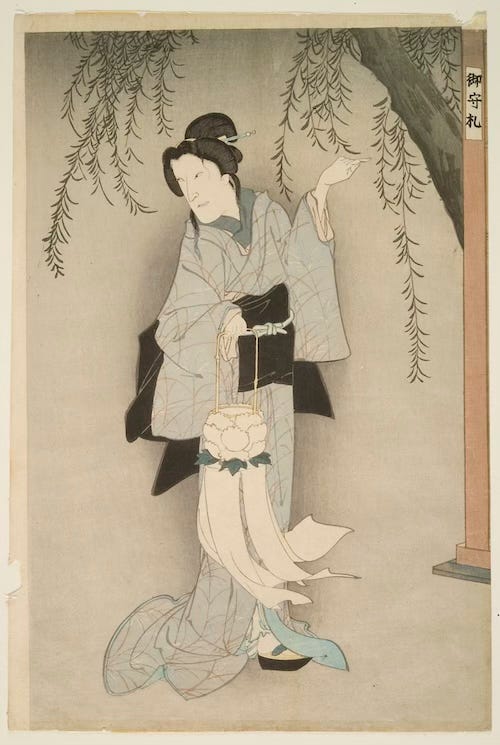
This tale is based on a famous ghost story that takes place in Tokyo’s Nezu neighborhood, about 45 minutes from my home in Yokohama. “Botan Dōrō” (translation: The Peony Lantern) entered Japanese literary culture in the 17th century through the translation of a Chinese ghost story. In 1666, author Asai Ryoi adapted the story and set the tale in Nezu. Its popularity through the centuries inspired a kabuki play and later several movies. In my serialized novel “The Yōkai,” available for free on Substack, the main character Asami tells this modern version of the story to a gang of demons in order to save her life.
It’s the first night of Obon, the summer festival of the dead. The cicadas have sequestered themselves in the trees, invisible except for their loud whine that cuts through the humid night, stopping and starting, stopping and starting. It’s so hot that not even the weak fan swiveling back and forth, back and forth, can remove the perspiration from Takashi’s forehead and chest. The air blowing across his body is hot—hotter than the Buddhist hell his mother used to tell him about as a child, or so he imagines. He lies on the futon in his apartment in his underwear, legs and arms akimbo, not wanting the heat from his skin to touch any other part of his body. Jiya-jiya-jiya-jiya sing the cicadas through the open window. He likes the sound. It reminds him of chanting monks.
The cicadas stop their symphony of buzzing. How they always do this simultaneously, as if under a conductor’s baton, amazes Takashi. Although weak from the heat, Takashi raises up his body and leans back on his elbows. He can see across the courtyard to the windows of the dark apartments that look like so many wide-open eyes watching him. He watches a flicker of light emerge from the rear of one apartment and grow brighter as it draws near the balcony. A young girl about ten years old is holding a lantern. She slides open the glass door and steps aside. As she holds up the lantern, a beautiful young woman moves past her onto the balcony. Takashi presumes the beautiful woman must be the young girl’s older sister. Two hundred years ago the young girl might have been the woman’s assistant or acolyte, but these are modern times. The girl sets the lantern down and stands deferentially to the young woman’s left. Peony-shaped openings in the sides of the lantern cast lovely images that dance from the candlelight. The woman wears a lime green summer yukata decorated with white cranes, a black obi cinched across her midriff. Something about the colors and her expression strikes Takashi as sorrowful. He watches her, intrigued, but she offers no awareness that he is watching.
Some time passes. A silent clue cues the girl to pick up the lantern, and the two retreat into the apartment, the light growing smaller and smaller until it vanishes. An invisible baton signals the cicadas to resume their music.
The vision of the woman lingers in Takashi’s mind. Not even sleep can dispel the vision, and he dreams that she visits him, kneeling to wipe away the sweat on his forehead. Neither speaks. Behind her, the girl holds the peony lantern. The peony-shaped light caresses the bodies of Takashi and the woman as the candle flickers. When morning comes, he decides he must find out who she is.
He goes to the apartment where he saw her and knocks.
Silence.
He knocks again.
Silence.
He knocks a third time, unable to accept that his efforts will be unfruitful, but no one stirs within. His longing grows even stronger. Back in his room, he watches the apartment across the courtyard for hours, but no one stirs within. He has never wanted someone as much as he now wants the beautiful woman in the lime green yukata. All day long he agonizes. He hears taiko drumming from somewhere down the street. Women in light kimonos must be performing a bon-odori. Years ago he would attend these festivities with his mother, but hasn’t bothered since then. In any event, now he cannot tear himself away from his apartment. Shadows lengthen across the floor as the afternoon light turns golden. His mother would not be pleased to know that he has once again neglected to hang a paper lantern at his door to guide the spectral ancestors, something she always insisted on doing during Obon. But he hasn’t honored that tradition for years, and she is no longer around to remind him.
He awaits nightfall with impatience, not even bothering to fix dinner. He sits in the dark, waiting and watching, waiting and watching. At last, just as on the previous evening, the cicadas grow silent, and the ember of light glows in the apartment across the courtyard. His heartbeat quickens. Once again, the young girl with the peony lantern opens the sliding door as the beautiful woman steps onto the balcony. Once again, they both stand there in silence. The woman wears the same lime green yukata with white cranes. Takashi waves, trying to get her attention, but she seems not to notice. He races down the hallway and around two corners to reach her apartment, planning what he will say to her when she opens the door. But no one answers his knocks.
When he returns to his apartment, she has already vanished. Her empty apartment looks as hollow as his unsatisfied desire. The cicadas seem to mock him, their jiya-jiya a chorus of laughter. He can’t understand why no one answers the door. Again he dreams of her, kneeling beside him to wipe away his sweat. He looks at her and she returns his gaze with a sorrowful smile. He starts to ask her why she won’t answer the door, but she places her finger to his lips to quiet him, then bends over to kiss him. Her hair sweeps across his chest in a gentle caress. He feels the softness of her lips, the gentle hesitation of her tongue before she gives in fully. The kiss ends too quickly. He sees the glow of the peony lantern. Neither the girl nor the woman are there—just the lantern. Then he awakens to the light of morning and a day already hoarding its heat.
At the front desk, Takashi inquires about the occupants of the apartment. The lady behind the counter gives him a bewildered look. “Why, no one lives in that apartment,” she says. “It’s been vacant for quite some time.”
Takashi scoffs, saying that can’t be so, as he’s seen two people on two consecutive nights. Hearing their conversation, the Mouse scurries out from the back office (that is Takashi’s nickname for the tiny woman with the triangular face who works there, as she always emerges from her cubbyhole whenever she senses food or gossip).
“Stay away from that apartment,” says the Mouse, shaking her finger at him. “That place will only cause you grief.”
Takashi laughs. “What could possibly be so dangerous about a young woman and her sister?”
The Mouse and the lady at the counter look at each other with concern. Takashi senses they are reluctant to say more, and he begins to grow angry. The Mouse has never been helpful, sniffing around in everyone’s business, full of rebukes over every minor infraction of the rules. He concludes she is up to her usual tricks and dismisses the warning. He turns around and walks away, aware of their whispers but not hearing the words.
Takashi devises a ruse to get the Mouse out of the office so he can steal the key to the apartment. He pulls the fire alarm. The Mouse rushes out, not bothering to lock the door. While she is tending to the fake emergency, he steals into the office and takes the key. He believes it will be days before she notices the missing key—if she notices at all—giving him enough time to meet his mystery woman face to face, after which he can return the key to its place.
That night—the third and final night of Obon—he lets himself in to the apartment across the courtyard and waits while the sounds of night fill the darkness: the chirp of crickets, the chanting of cicadas, the occasional siren. He’s too wired to grow weary, despite the late hour, and sits on the floor with his back erect. Then, just as before, the cicadas grow silent. The light from the peony lantern appears in the next room. The girl steps through the door. Behind her comes the young woman. She is even more beautiful up close, a peach blush on her cheeks, skin persimmon smooth, a scent like orange blossoms filling the air. She sees him but doesn’t seem surprised.
“I’m sorry for intruding uninvited, but I had to meet you,” says Takashi, jumping to his feet and bowing his head in deep apology. “I only entered because you never answered any of my knocks.”
The woman motions for the girl to set down the peony lantern, then speaks. “Do not trouble yourself over the intrusion. You are here now, and I am glad.” She smiles and holds out her hand, which Takashi takes in his own. She leads him into the other room, the folds of her lime green yukata with the white cranes swishing with each step. She indicates for Takashi to lie down on the floor, then kneels beside him and, just as in his dreams, wipes the sweat from his forehead. He starts to ask her why she didn’t answer his knocks, but she holds her finger to his lips to silence his words, then bends over and kisses him. Not even his dream can match how sensuous her lips are, like the ripest, juiciest Amaou strawberries.
They lie together all night long in bliss. Afterward, entwined in an embrace, Takashi feels they have already become lovers and imagines many more passionate nights stretching into the future. How pleased he feels and nuzzles her orange blossom-scented neck. Just before dawn, as Takashi begins to drift off at last into sleep, he hears the front door open. Tip-toe tip-toe comes the Mouse, nosing about as she is accustomed to do. At least, he decides it must be her. Who else would think of coming into this empty apartment at dawn? She must have noticed the missing key after all and come up to investigate. He can hear her sniffing around the other room. For a moment, he regrets having neglected to lock the door when he snuck in and fears being discovered in such an intimate position. Then he begins to chuckle and pulls the beautiful young woman closer into his embrace.
The Mouse steps into the room. Takashi can see her in the wan light. He is not surprised when she gasps and brings her hand to cover her mouth. But the cry that bursts from her lungs immediately after startles him. That’s when Takashi notices he is holding a skeleton in a tattered lime green yukata.
He pushes the skeleton aside as he scampers to his feet. The skull stares up with that familiar sorrowful smile. Small skeletal hands stick out from the yukata’s grimy sleeves. The tightly cinched obi has come undone, and the yukata that once hugged the swan-like body sags around yellowed bones.
The Mouse sobs and hides her face in her hands. “I warned you,” she says. “Now you are marked for death, because you are hers forever.”
Takashi stands there dumbstruck at first, unable to believe this is not some hallucination or a terrible prank that they all conspired to play on him. He rushes past the Mouse and out of the apartment, careening down the hallways. He flees from the building and keeps running and running until he stops at last to bend over with his hands propped against his wobbling knees and gasps for breath. A few people pass him, already on their way to work dressed in somber suits as the sun lingering just below the horizon continues to brighten the sky. They pay him no mind. He straightens his back and looks at each passing stranger. No one looks him in the eye. Perhaps he is already dead, a ghost wandering the streets. Their uniformly dark suits make him imagine he is at a funeral. He looks down at his hands, thinking how they caressed such a lovely body during the night but now are tainted with the touch of the tomb.
He wanders the city for hours, down one street, down another, past shops and restaurants and houses where people are going about their lives. No one seems to sense the anxiety in his gait. He returns to his building as night falls and seeks out the Mouse in her office. She knows at once why he has come and tells him what he yearns to know.
“She lived on these premises two hundred years ago, long before this building was built,” says the Mouse. “She was a noblewoman with a young servant who always carried a peony lantern to light the way each evening. The noblewoman fell in love with a samurai who promised to marry her and love her forever. But her father, a powerful lord, disapproved, as he had his own designs for who his daughter should marry. When he learned of their plans to run away together despite his edict, he had the samurai killed. Once she heard of this, she slit her own throat on the very spot where the apartment stands today. Overcome with grief, her assistant also killed herself, as she loved her mistress like an older sister. People say the young lady appears every year during Obon, seeking to rekindle with someone the love she once felt for the samurai.”
Upon finishing the story, the Mouse sits behind her desk in silence, her hands folded in her lap. Takashi does not bother to ask what will happen next, as he already understands. Without a word, he leaves.
He sits in the gloom of his apartment while the cicadas chant the Amitabha Sutra for the passage of souls from this world to the next. Toward midnight comes a knock on the door. He thinks it must be the Mouse coming to check on him to see if he is okay. Instead, when he opens the door, he sees the girl with the peony lantern. She beckons for him to follow, and he knows that he has no choice.
He follows the lantern light down lonely streets, past houses dark and shuttered. The two turn one way then another, the lanes growing narrower and narrower, until at last they come to an old graveyard. Jumbled dark circles and rectangles tilt and lean, the silhouettes of weathered tombstones. Takashi follows the girl into the graveyard. She sets the lantern down beside one grave. Takashi kneels in the grass and touches the grave marker. Despite the hot summer night, the stone is cold, so cold. He presses his cheek against it. The scent of orange blossoms infuses the night air. He closes his eyes and lies down in the grass. He feels someone wipe the sweat from his forehead. The last thing he realizes in his final moments is that in the morning, when they find his body, he will be sprawled beside a peony lantern, its candle spent.
This story appears in my serialized novel “The Yōkai,” available for free on Substack. The main character Asami tells this tale to a gang of demons in order to save her life.
Thanks for sharing my story.